Your address doesn't settle it. Your location at the moment you click "join" does, and that's the whole rule for most people looking into online IFS therapy in Washington · telehealth. The setup is small too: a door that closes, a laptop or phone with a camera, and headphones if you share walls.
The edges take a little more explaining. Maybe a work trip to Boise lands on your session day, or the counselor you like turns out to be licensed in Oregon. And some bios mention IFS without saying where the training came from. Each of those has a plain answer.
TL;DR Quick Answers
Online IFS Therapy in Washington · Telehealth
Yes. Any adult who is physically in Washington when the session starts can see a Washington-licensed IFS therapist by secure video, from Seattle to a town three hours from the nearest IFS-trained provider.
Who qualifies: Adults 18 and older who are located in Washington at session time. Your home address doesn't decide it.
What you need: A device, a door, headphones.
What a session is like: About 50 minutes at a slow pace. On hard days, the camera can stay off.
If you travel: Sessions from outside Washington usually get rescheduled.
Before you book: Confirm the license on Washington's provider credential search and ask where the therapist trained in IFS.
First step: A free 15-minute call with Lauren Rath Therapy.
Top Takeaways
Location beats residence. You need to be physically in Washington during each session.
Out-of-state therapists need authorization here. That means a Washington license or a valid compact privilege.
Travel usually means rescheduling. Plan around trips before you book.
Verify the license and the training. Use the state's credential search, and look for IFS Institute Level 1 at minimum.
You need less than you think. A camera and a door that closes get most people started.
Who Qualifies for Online IFS Therapy in Washington
Any adult who is physically in Washington during the session can work with a Washington-licensed IFS therapist by video.
Therapy spans everything from open-ended talk to tightly structured methods. Internal Family Systems sits at the gentler end. It treats the mind as a set of parts, each doing a job it picked up for a reason. One plans everything three weeks out. Another goes silent the second someone raises their voice. An IFS therapist gets curious about those parts and doesn't argue with any of them.
To start, you'll need:
To be 18 or older, since many IFS therapists in private practice see adults only
To be physically in Washington for each session
A phone, tablet or computer with a camera
Somewhere you won't be overheard, on a connection that mostly holds
Nobody needs a referral, and you don't need to know anything about IFS. Most people arrive never having heard of it.
Fit is its own question. A therapist who works with adults one on one may not be the right person for couples, teenagers or active substance use. That's about fit, and it says nothing about you.
Why Your Location During the Session Matters
Counseling licenses follow the client, so the state you're sitting in on a given day decides who can legally see you.
A therapist licensed here can meet with you in Bellingham or Walla Walla, and the hour looks the same either way. Rural counties feel that most. Out there, the closest IFS-trained therapist can sit three hours away over a mountain pass.
The same rule cuts the other way. A Seattle resident spending a week at a cousin's place in Idaho falls outside the license for that week, while a student from Montana living in Pullman for the school year falls inside it.
Traveling, Moving and Out-of-State Therapists
Leaving the state usually means rescheduling. A therapist licensed somewhere else needs authorization to practice here before they can see you.
Washington's telehealth law lets an out-of-state practitioner treat someone located in Washington if they hold a Washington license or a privilege through a multistate compact the state has joined. One narrow exception covers follow-up care. A mental health practitioner can keep seeing an established patient who is only in Washington temporarily and who received treatment in the state where that practitioner holds a license.
Washington lawmakers passed the Counseling Compact in 2023 . Over time it should make it easier for counselors from other member states to work with people here, though how far it reaches today depends on the compact's rollout. If an out-of-state counselor tells you they're covered, check with the Washington Department of Health before your first session.
What Online IFS Sessions Actually Look Like
Most online IFS sessions run about 50 minutes over secure video, at a slow pace, from whatever private corner you've got.
The first hour is mostly two people getting a feel for each other. Your therapist will ask what brought you in and what you'd like to be different. You can answer clumsily. Nearly everyone does.
After that, the attention turns inward. Maybe the part that worries shows up, or the one that keeps pushing, and the two of you spend some time getting to know it. Nobody pries anything open before you're ready.
Plenty of people take sessions from a parked car. Others use a bedroom with a box fan running in the hallway. On days when some part of you needs the camera off, turn it off.
How to Confirm a Therapist Is Licensed and IFS-Trained
You can check a therapist in about five minutes with one search and one direct question.
Search their name in Washington's provider credential search.
Look at the license type, such as LMHC, LICSW, LMFT or psychologist, and make sure it's active.
Ask where they trained in IFS. The IFS Institute treats its Level 1 training as the minimum for calling yourself IFS-trained .
Book the free consult most practices offer, and notice how you feel on the call. That counts for something too.
Where Body Image and the Inner Critic Meet
People weighing a cosmetic change often meet a loud inner critic first. IFS treats that voice as a part worth understanding, which is a different project from trying to shut it up.
It's the part that zooms in on every photo and keeps a running list. It usually took that job on young, and it honestly believes it's protecting you.
None of this makes a procedure right or wrong for you. That call belongs to you and to finding the right provider. What IFS can give you is a quieter place to decide from, where the critic gets heard without getting the final word.
"People arrive braced. They're expecting a verdict about what's wrong with them, and instead a part of them gets listened to for the first time in thirty years. Then the whole system exhales. I've watched it happen on a screen from four hundred miles away."
Essential Resources
Where to look next, whether you're still deciding or nearly ready to book.
Check a License Before You Book
Washington's Department of Health keeps a public lookup of licensed providers and updates it daily, disciplinary actions included. Type in a name to see the license type and whether it's active.
Source: Washington Provider Credential Search
Read the Rule on Out-of-State Therapists
This short state law spells out when a practitioner licensed elsewhere can treat someone sitting in Washington. It runs three subsections and reads more plainly than most statutes.
Source: RCW 18.134.050, Out-of-State Health Care Practitioner
See Which States Share Counseling Licenses
The Counseling Compact's own map shows which states have joined and links to each state's legislation. Take a look if your counselor holds a license somewhere else or you're planning a move.
Source: Counseling Compact Member Map
Learn About IFS From the People Who Train It
Richard Schwartz founded the IFS Institute, which runs the official training pathway for the model. Its site walks through parts and Self, and what a therapist has to complete to call themselves IFS-trained.
Source: IFS Institute
See What Therapy by Video Can Cover
This federal guide lays out behavioral health care over telehealth, from one-on-one therapy to screening and medication follow-up. Start here if the format is new to you.
Source: How Do I Use Telehealth for Behavioral Health Care?
Keep Your Session Private
Here's practical advice on where to sit and how HIPAA covers what you say. It also warns against public Wi-Fi and shared devices, and a parked car makes its list of good spots.
Source: How Do I Protect My Data and Privacy?
Know What Happens If You Reach Out Tonight
Therapy isn't a crisis line. If you need someone right now, this page walks through what a call, text or chat with 988 is like, one step at a time.
Source: What to Expect From the 988 Lifeline
Supporting Statistics
These numbers shape how we think about the location question in Washington.
Half of People Who Could Use Help Go Without It
In 2022, about 59.3 million U.S. adults lived with a mental illness, and only 50.6% of them received any mental health treatment that year.
That's roughly one person in two.
Distance and waitlists account for a good share of the gap, and so does the nerve it takes to send that first email.
Telehealth won't close the gap by itself, though it does take the drive out of the equation.
Source: NIMH Mental Illness Statistics
Video Became an Ordinary Way to Do Therapy
Telehealth went from almost no outpatient mental health visits before 2020 to 36% of outpatient mental health and substance use visits between March and August 2021. Rural patients leaned on it harder, at 55% of visits compared with 35% in urban areas.
The people with the fewest local options picked it up fastest, which matches what therapists hear from small-town clients.
Source: KFF: Telehealth Has Played an Outsized Role Meeting Mental Health Needs
Most Washington Counties Are Short on Mental Health Providers
The Washington State Health Assessment found federal Mental Health Professional Shortage Area designations covering 35 of the state's 39 counties.
Therapists with specialized training like IFS are scarcer still.
For much of the state, online care is simply the option that exists.
Source: Washington State Health Assessment: Access to Behavioral Health Providers
Mental health statistics show that nearly half of U.S. adults with mental illness went without treatment in 2022, while telehealth has become an important option for people facing distance and access barriers. With 35 of Washington's 39 counties designated as mental health provider shortage areas, online therapy helps connect residents with healthcare professionals, including therapists trained in specialized approaches like IFS, without requiring long trips for in-person care.
Final Thoughts and Opinion
Eligibility turns out to be the easy part. Be in Washington, see someone licensed here, and you're covered. That describes almost everyone reading this.
Fit is where people rush. They find a name in a directory, spot "IFS" in the bio and grab the first open slot. A few months later they learn the therapist took one weekend workshop and mostly practices something else.
Here's the opinion we'll stand behind. For online IFS, training and pacing matter more than proximity, and a well-trained therapist four hundred miles away will usually serve you better than a loosely trained one across town. Everyone assumed the screen would be the weak point. For inward work like this, it rarely is.
A few patterns come up again and again:
People worry most about being overheard, and that worry fades faster than they expect.
Nearly everyone finds the first session awkward, which says nothing about whether the work will help.
Rural clients often describe online IFS as the first time specialized care felt possible at all.
The part that wants to do therapy correctly usually has to relax before much else can move.
So ask the training question on the first call. A good IFS therapist won't mind.
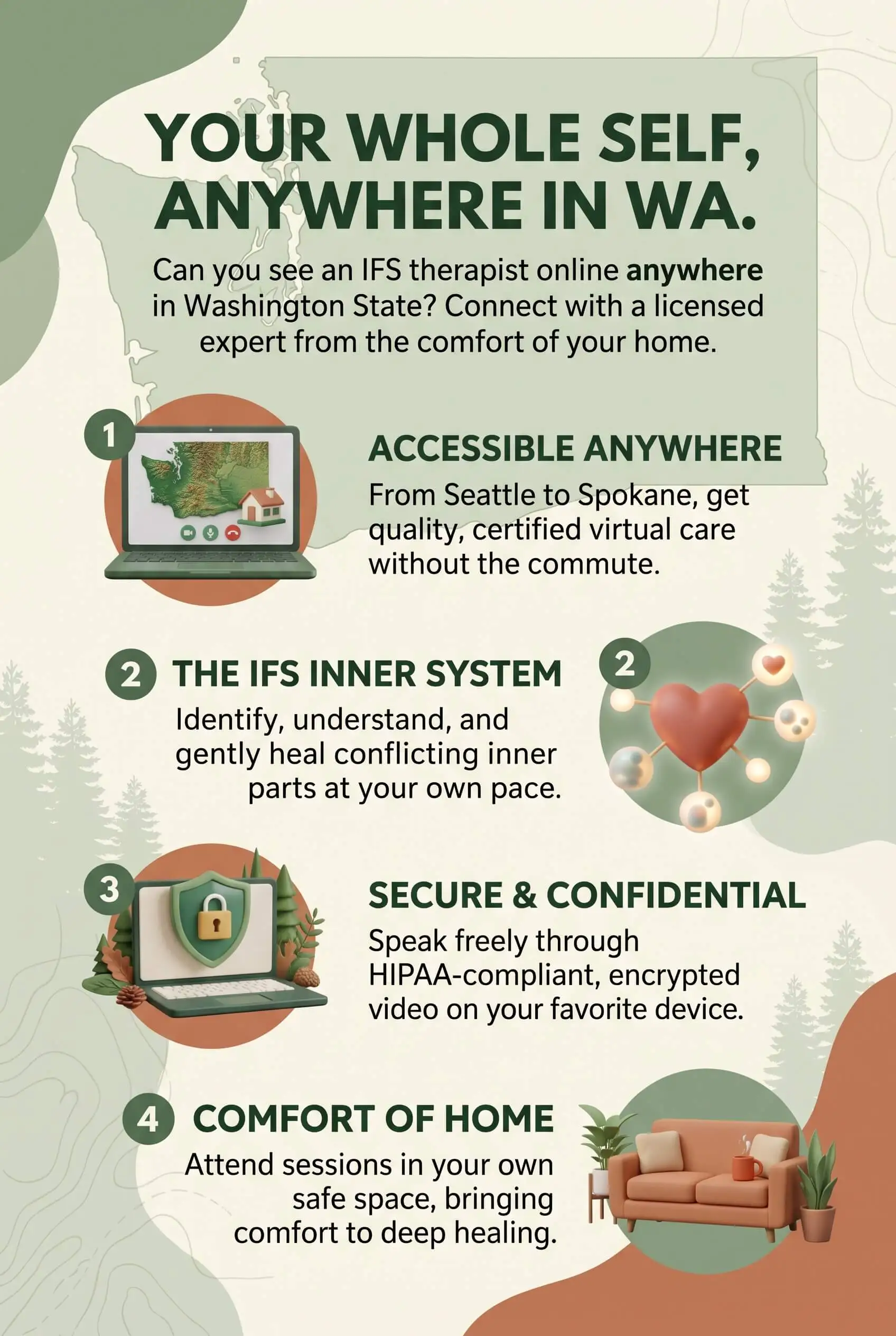
Frequently Asked Questions
Q: Do I need to live in Washington, or just be there during sessions?
A: Just be there. Your physical location at session time is what counts. A student from Idaho living in Spokane qualifies, and a Seattle resident spending the week in Portland doesn't, at least for that week.
Q: Can I keep my sessions going while I travel out of state?
A: Usually not. A Washington license covers clients who are in Washington, so most therapists will reschedule rather than meet with you across the border. Ask about their travel policy before your next trip.
Q: Can a therapist licensed in another state see me online?
A: Only with a Washington license or a valid compact privilege. State law carves out a narrow exception for continuing care of an established patient who is here temporarily. Washington joined the Counseling Compact in 2023 , so confirmed any privilege with the Department of Health.
Q: Does online IFS work as well as in person?
A: Lauren Rath came to telehealth skeptical, and in her experience it does. The work happens inside you, so the room carries less weight than people expect. Some clients go further at home than they ever would in an office.
Q: What do I need for an online session?
A: A phone, tablet or computer with a camera, plus a private spot and a connection that mostly holds. Headphones help. You don't need to read up on IFS beforehand.
Q: How do I know a therapist is actually IFS-trained?
A: Ask where they trained. The IFS Institute considers Level 1 training the minimum for calling yourself IFS-trained . Then look up their license on Washington's provider credential search.
Q: Does insurance cover online IFS therapy in Washington?
A: Often, yes. Washington requires state-regulated health plans to cover telehealth , and many IFS therapists are in-network with major carriers. Lauren Rath Therapy, for example, works with BCBS, Aetna, Regence, Premera and Cigna.
Q: What if I don't have a private space at home?
A: A parked car works, and more people use one than you'd guess. So does a closed door with a fan running outside it. Tell your therapist at the start and you can adjust together: quieter voices, more writing, camera off.
Q: Is online therapy a crisis service?
A: No. If you're in immediate danger, call or text 988, or dial 911. Therapy is for ongoing work.
Take the First Step
Reaching out asks more of a person than it looks like from the outside, and some part of you may already be talking you out of it. That's allowed. When you're ready, one sentence is enough to start. Lauren Rath Therapy offers a free 15-minute call for adults anywhere in Washington, so you can get IFS therapy explained and see how it feels before you decide anything.
